How Solar-Powered Smart Birdwatching Devices Reduce Disturbance to Birds While Supporting Long-Term Behavioral Observation

Anyone who has spent real time watching birds knows the frustrating part isn’t the birds — it’s everything around them. You set up a feeder, you get excited about tracking who shows up, and then the process of “monitoring” ends up being the thing that scares them off. Cautious species are not intimidated by a presence of humans that occurs repeatedly every couple of days, changing batteries, adjusting an angle or pulling an SD card.
The silent issue that has been lurking under the radar of backyard birding and field study on a small scale for several years. The more attention you wish to pay to a site, the more you run the risk of disturbing the site. One of the more practical solutions to the problem is solar powered smart water feeders, and as more people are seeing them in use, it’s worthwhile to discuss how they work.
Why Human Visits Are the Real Disturbance
Birdfy don’t generally react badly to a stationary object near their food source. They react to movement, noise, and unfamiliar shapes approaching repeatedly. A camera sitting quietly on a pole isn’t the issue — a person walking up to it every few days is.
Traditional setups almost force this.Batteries run out, memory cards fill up and someone has to go and deal with it. Well-managed quiet visits accumulate over weeks and studies on nest site disturbance have demonstrated that, for some birds, they can adjust their feeding schedule, stop using a location entirely, or even abandon a nest site if they detect a regular schedule of disturbance.
So it’s not about “bigger cameras,” it’s about “better cameras. .” It’s fewer reasons for a person to show up at all.
What Solar Power Actually Solves
This is where the solar piece matters more than it sounds. A small panel keeping a device charged means nobody has to go swap batteries every week. As long as there’s reasonable daylight, the unit can run on its own — through rain, cold mornings, cloudy stretches — for weeks or sometimes months without anyone walking up to it.
A few things follow from that pretty naturally:
- Birds settle into normal patterns instead of staying on edge from repeated visits.
- Footage keeps recording through early morning and dusk hours, when a lot of species are actually most active — hours a person would rarely be out there checking equipment anyway.
- Everything can be checked from an app, so “monitoring” becomes something that happens from a couch, not from standing next to a feeder.
None of this is complicated technology on its own. What makes it useful is that it removes the human factor from the equation almost entirely.
The “Smart” Part Is What Makes the Data Useful
Solar charging keeps a camera running. But running constantly just gives you hours and hours of raw footage — which isn’t especially useful unless something is helping you make sense of it. This is where on-device recognition comes in. Modern smart feeders can identify species as they visit, log how often a particular bird shows up, and flag movement automatically instead of leaving someone to scrub through days of video by hand.
Over a long enough stretch, this kind of automated logging starts to show things that would be almost impossible to catch by just watching occasionally:
- Which species show up more in certain seasons
- Activity spikes tied to temperature swings or weather fronts
- Behavior changes after a new bird, or a predator, starts appearing nearby
- Slow shifts in which species are present at a location year over year
For someone tracking backyard biodiversity, or contributing to a citizen science project, that’s a very different kind of dataset than what you’d get from checking in a few times a week. It’s not just more data — it’s more honest data, because the birds aren’t adjusting their behavior around a person standing there.
A Practical Example
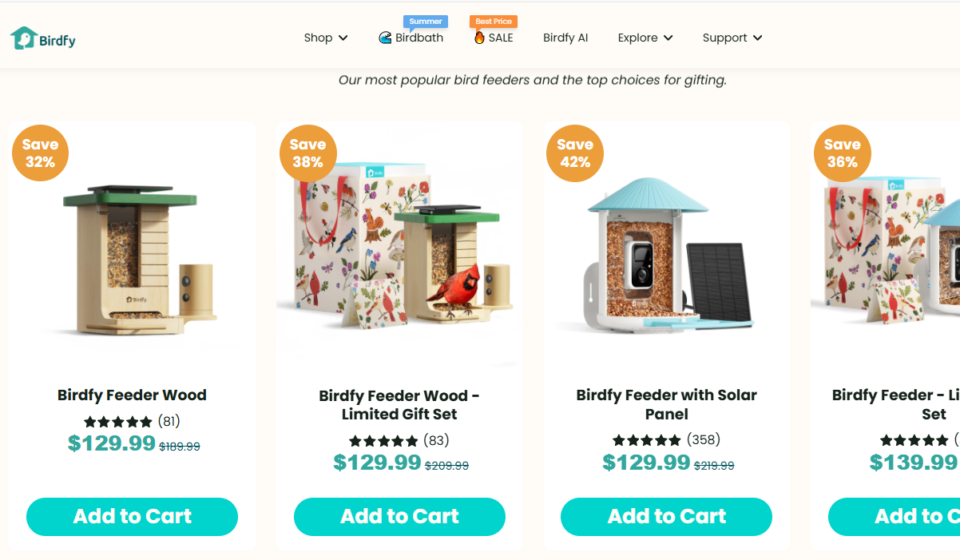
Feeders like the camera bird feeder line from Birdfy are a decent example of where this is heading — solar charging paired with recognition software in one unit, built so it can be left alone for long stretches while still producing usable behavioral data.
Where This Fits in the Bigger Picture
Solar-powered smart feeders aren’t going to replace formal field research, and nobody’s claiming they should. But for the in-between space — backyard observation, citizen science, casual long-term tracking — they solve a problem that’s been around for a long time: how do you actually watch something closely without changing how it behaves just by being there?
Fewer visits, less disruption, and data that keeps accumulating quietly in the background turns out to be a pretty good answer.

ftllqnrijlerdzdxdfmngxokdtgzdz